Three uniquely well preserved pre-conquest sculptures, were protected, possibly in norman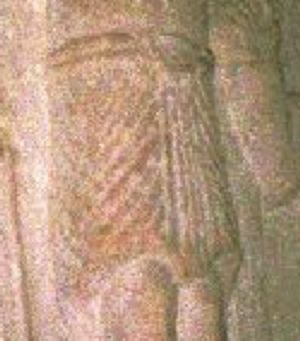 times,
by being reversed, with their cut surfaces facing into the wall interior, and were only recovered
during a 19th century restoration. Their clean cut, crisp rendition now make them look like modern
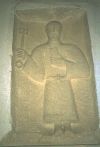
sculpture! They consist of: an allegorical St. Peter,
dressed as the then current tonsured priest,
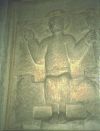
holding up the key to heaven; the risen Christ ascendant and enthroned, holding a cross in the
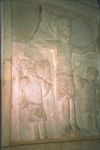
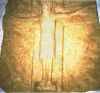
left hand, and with other giving the sign of benediction; and a detailed Crucifixion scene, with two
'roman' soldiers, one with a spear ('Longinus'), the other with the sponge on a stick ('Stephaton'). It
is interesting that all three figures in the latter scene appear to be dressed in kilts, with a degree of
decoration on Christ's, which looks almost like a tartan. The last two sculptures appear less well
preserved, due to longer external exposure. They consist of a very worn crucifix high on the
transept wall and an external sun-dial over the door.
times,
by being reversed, with their cut surfaces facing into the wall interior, and were only recovered
during a 19th century restoration. Their clean cut, crisp rendition now make them look like modern
sculpture! They consist of: an allegorical St. Peter,
dressed as the then current tonsured priest,
holding up the key to heaven; the risen Christ ascendant and enthroned, holding a cross in the
left hand, and with other giving the sign of benediction; and a detailed Crucifixion scene, with two
'roman' soldiers, one with a spear ('Longinus'), the other with the sponge on a stick ('Stephaton'). It
is interesting that all three figures in the latter scene appear to be dressed in kilts, with a degree of
decoration on Christ's, which looks almost like a tartan. The last two sculptures appear less well
preserved, due to longer external exposure. They consist of a very worn crucifix high on the
transept wall and an external sun-dial over the door.
The excellent preservation of the three main sculptures makes them unique in British pre- conquest history. Their closest parallels in both style and form are with the Irish high crosses of the 10th and 11th century, such as the crosses of Muiredach and Dysert O'Dea. (L. Laing 1975, pl. 31 & 32A) or their poorer copies, such as the cross slab from Llan-gan, West Glamorgan (M.Redknap, 1991, p.68). It is these affinities, together with nature of the atire, which probably prompted the assignation of pre-conquest, rather than saxon, in the one existing online description of these sculptures at Daglingworth Holy Rood Church.
I have recently found a published picture of the St Peter sculpture (M.Hare 1993, pp.24-5), where it is more recently dated.... "There are few large-scale images of St Peter from Anglo-Saxon England. There is however a statue of him at Daglingworth in Gloucestershire (Fig.2), probably belonging to the second half of the 11th century or even early 12th century. Whatever the exact date of the sculpture, it is a traditional Anglo-Saxon representation of St. Peter, beardless and tonsured. It is pleasant to reflect that at Daglingworth we may possibly have a rustic reflection of a major image of St Peter at Gloucester commisioned by Ealdred, [AD1058]."
 Return to the Archaeology Page