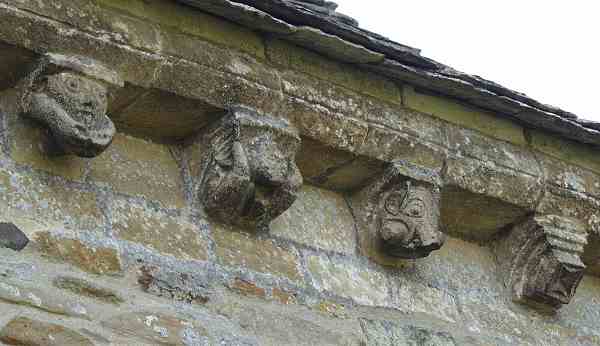
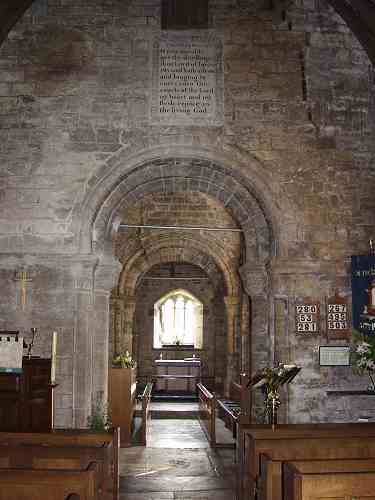
Back in April 2002, my wife and I spent a few days in Dorset and with the aid of our copy of Simon Jenkins England's Thousand Best Churches, discovered a small group of beautifull, early churches in the Isle of Purbeck. Coming in from the Sandbanks chain ferry, the first church we came across is St Nicholas at Studland. Although superficially early Norman in appearance, the main body of this church is Saxon, including the base of the tower. The original church was built of an irregular rubble construction. The Normans merely strengthened this structure with buttresses to the tower and quoins at the corners. The top was strengthened with an ashlar layer with corbels, many of animals and distorted human heads (see below). The inside is pure early Norman and is particularly dark, because of the narrow slit windows. The displaced section of the arch, shown below, is evidence of the very precarious state of the building, when in 1880, the Society for the Preservation of Ancient Buildings, prompted the rector, the Rev. C.R. Digby and his Church wardens to undertake a "vigorous restoration", well recorded by W.M. Hardy 1891. The later plainly states at the end of his text (p.179), that .. "From architectural peculiarities traceable in Worth [Matravers] and Studland Churches, and S. Martin's Church at Wareham, these buildings, in their original form, may be assigned to the time of S. Aldhelm, if not to his personal superintendence."(the emphasis is mine).
I have recently aquired a copy of Lundgren & Thurlby's 1999 article from the Dorchester Museum, which completely rejects Hardy's Saxon dating (see the newly downloadable copy of Hardy's article). These Author's, mainly on the grounds that "In the first place, it must be why anyone would go through the incredibly arduous process of cutting away existing masonry, on both the exterior and interior of the church, to insert some ashlar blocks in walls that were almost certainly going to be plastered, (pp. 6-7). The answer to this, is that this is exactly what the Norman builders did, inorder to disguise the Saxon origin of their newly taken over churches and also to help blot out the memory of a significant local Saxon, St. Aldhelm; they were minority invaders and wanted to re-write history in their own mould. In other words pure propaganda. In any case the Normans were anything but inefficient, so why pull down a perfectly adequate church, when it can easily be converted! Pity that they did not clear the site in some ways, as the subsequent new church would have had far better foundations! The poor clay based foundation created the need for Hardy's restoration, it was the Norman additions to the tower and the chancel arches which were in danger of collapsing, so what we now see internally, is largely the Norman features, which the Victorian restoration was intended to preserve!
Although there is currently little visible evidence of the Saxon origin of Studland, as the church we now see is almost exclusively Norman in most of it's salient architectural features, I prefer to take Hardy's view, since he was present when fairly extensive excavation and some demolition, during this restoration was carried out. He was thus in a unique position of seeing the actual physical contact, between the rubble core and the applied ashlar. The killer argument in this matter, is Worth church (see below), which has preserved a typical Saxon doorway blocked up by subsequent ashlar, in an otherwise almost totally rubble construction, identical in so many features, to that of Studland. From my own personal investigations of numerous other supposedly Norman, rubble based churches, such as those on the S. Downs, many previously dated as totally Norman, turn out to have clear Saxon features. Thus Lundgren & Thurlby's (p. 7) statement that "More importantly, the rubble masonry of the nave is paralleled in countless churches in Norman England" may appear to be true, but what must actually remain open to question, is how many of these are also Norman camouflage jobs!!!
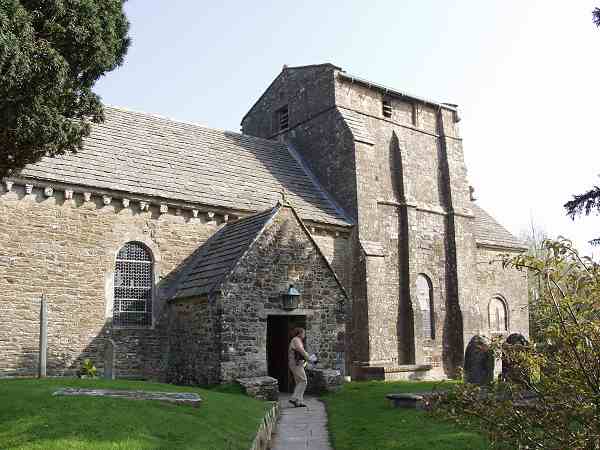
General view of south face of St Nicholas, Studland, showing the rough nature of the original stonework to the left, contrasting with the regular ashlar found in the buttressing of the tower.
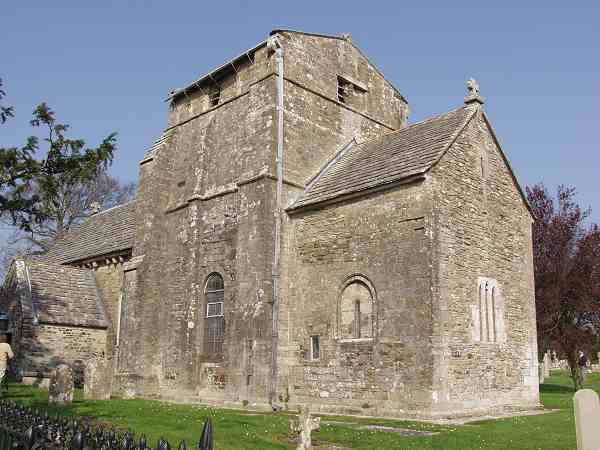
The west end of the church, showing the tower and the curious inset window towards the middle. It has been suggested (Hardy, 1881, p.173) that this was originally a Saxon slit window, with both an internal and external splay, as at St. Lawrence, Bradford-on-Avon, and that the Normans merely inserted jambs and arches in the outside part of the window, accounting for the two arches, one inside the other, see Hardy (1881, pl. 1, fig.2) .
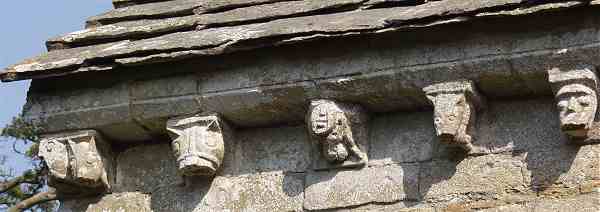
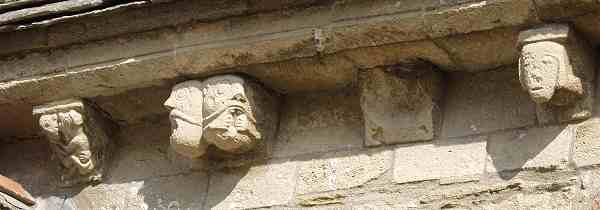
Corbels along the east end of the south face, in this and the next two pictures. The last is from the north face, which clearly shows the junction between the regular Norman ashlar and the Saxon rubble walling. There is plenty of evidence of iconoclasm, with missing and damaged figures.

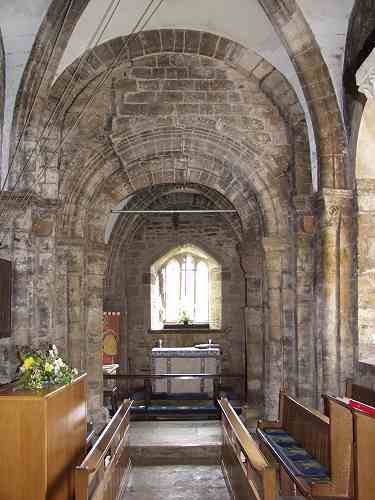
View East into the chancel, the subsidence damage is clearly visible, much of the centre of the chancel arch has dropped, as the result of two large cracks. During the restoration it was found that this had previously been repaired only with the aid of wooden wedges, subsequently covered with plaster. When this was removed in the late 1880s, it was found that the wood had rotted away, and that the whole thing was held up by dust, which just trickled out! (Hardy, 1891.p. 168). The injection of portland cement, "rammed in", fortunately stabilised the structure.
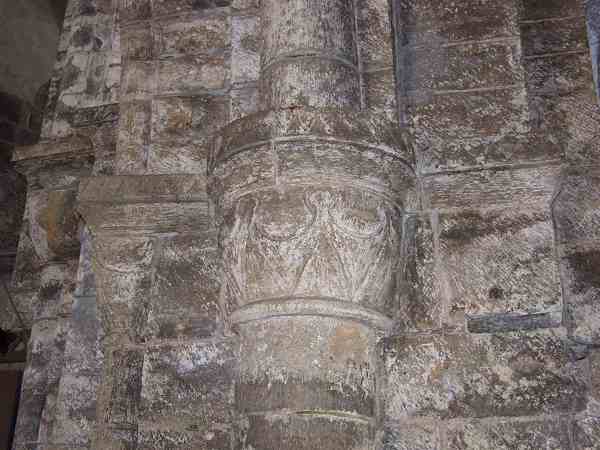
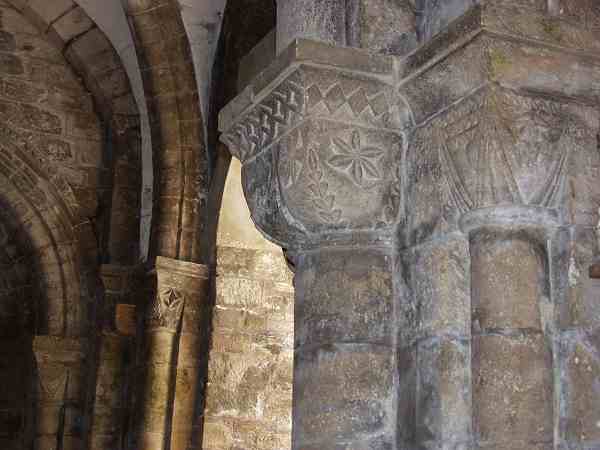
Decoration of column capitals, here form the north side, but in the two following from the south chancel and nave arches.
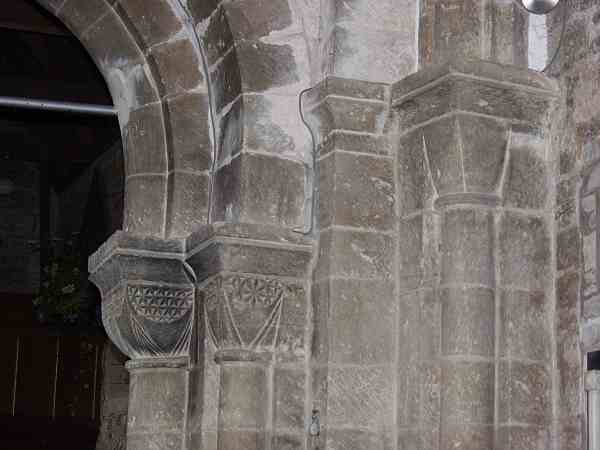
Note in particular one of the iron bars put in place during the restoration, to prevent the spreading of the walls! (see Hardy 1891, p. 167)

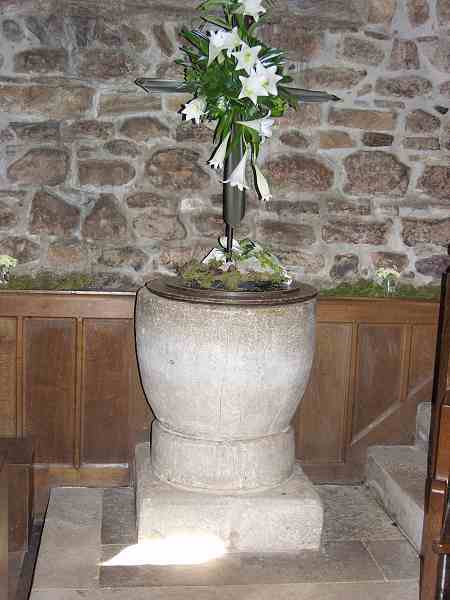
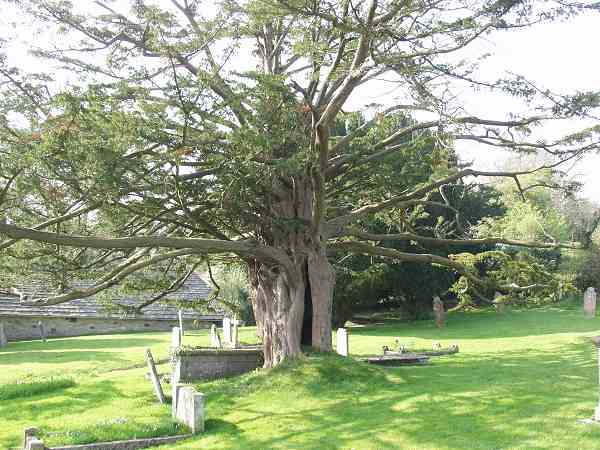
From Studland, we moved on to Swanage, and a round trip to Corfe on the Swanage Steam Railway, which trip will eventually be recorded on my steam pages. The next chuch visited was another St Nicholas, this time at Worth Maltravers. This village has a rather unusual public house, the Square and Compass. I think that Simon Jenkins (p.165) spent more time there than he should, since he describes Worth's church as a Norman structure, which it clearly isn't, as described here! (272 Kb of images)
References
K Lundgren & M Thurlby 1999, The Romanesque Church of St Nicholas, Studland (Dorset).
Proc. Dorset Nat. Hist. & Antiq. Field Club, vol xxi, pp.1-16, figs, 1-21.
S. Jenkins, 2000, England's Thousand Best Churches.
Penguin Books, London, ISBN 0-14-029795-2, £16.99.
W.M. Hardy 1891, A study on the work of preservation of the Church of St Nicholas, Studland, Dorset.
Proc. Dorset Nat. Hist. & Antiq. Field Club, vol xii, pp.164-179, pls, 1-3.
Download a copy of the above article by clicking here, have patience, a 1Mb PDF file!
